
The Edit · Historical and cultural analysis
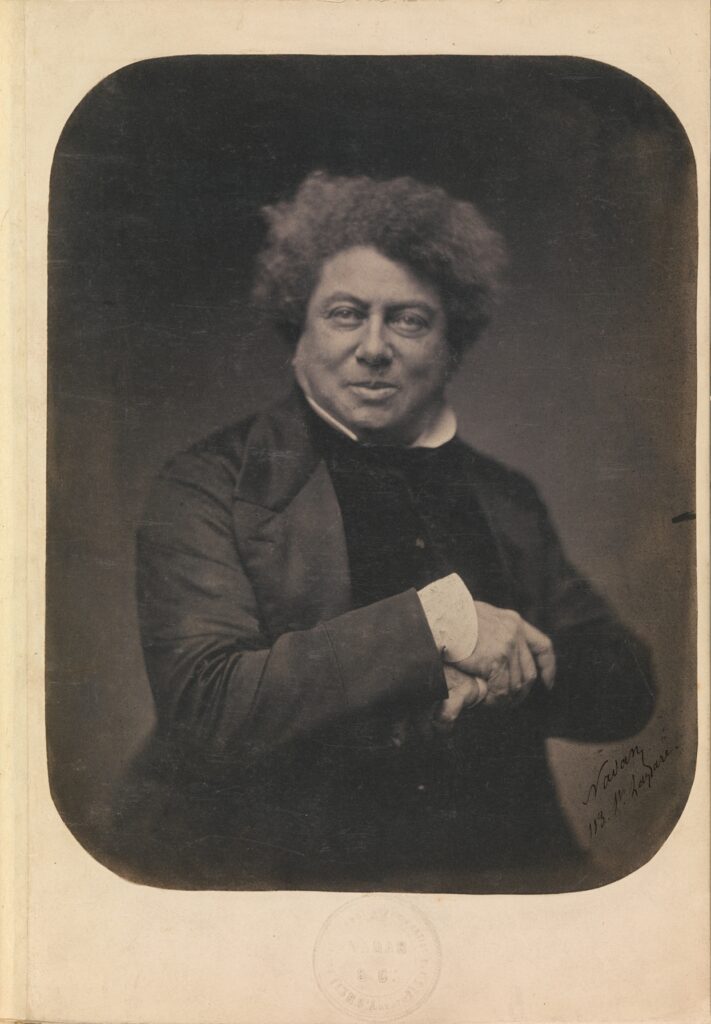
Nadar, Alexandre Dumas [Plate in Album], November 1855. The Metropolitan Museum of Art, Gilman Collection, Gift of The Howard Gilman Foundation, 2005 (2005.100.371). Public domain / CC0. Literary illustration; not evidence of a particular factory reading or naming decision.
The literary connection is clear in the brand's own account. The familiar factory-reading story requires a more careful distinction between tradition, retrospective testimony and documentary proof.
Montecristo carries a novel inside its name. The connection to Alexandre Dumas's The Count of Monte Cristo has become a familiar part of the Cuban brand's history.
The more complicated question is how that connection was made. A novel being read in a factory, workers enjoying it and a business choosing a name are related claims. They are not the same event, and evidence for one does not automatically prove the others.
The story the company tells
Habanos attributes the name to Dumas's novel and describes its popularity when read aloud to cigar makers. Its account dates the brand's founding to 1935. [1]
This is a source for the company's explanation of its name. It is not a surviving 1935 record of the naming decision. The page does not reproduce a meeting minute, a letter from the person who selected the name or a contemporary account establishing how the decision was reached.
The factory setting also differs between accounts. Habanos places the 1935 founding at H. Upmann. Writing in 2019, David Savona credits Alonso Menendez with creating Montecristo after acquiring the Particulares factory in 1935, and places the acquisition of H. Upmann later. [4] Neither account supplies a contemporary record of the naming decision.
These differences do not disprove the literary connection. They show why the setting and the choice of name need their own evidence.
Why the reading tradition matters
Reading aloud in cigar factories is not simply a decorative detail invented to explain Montecristo.
According to its publisher, Araceli Tinajero's El Lector traces the practice from nineteenth-century Cuba into other cigar-making communities. The University of Texas Press describes a study grounded in newspapers, journals and interviews with readers. Its subjects include the selection of reading material and the relationship between workers and factory owners. [2]
That wider history makes the literary association understandable. But a documented reading tradition cannot be used as a substitute for evidence about one particular naming decision.
It also deserves to be considered beyond its usefulness to a commercial origin story. The workers and readers belonged to a cultural world with its own choices, disagreements and interests.
What a legal record adds
A 2016 decision by the US Trademark Trial and Appeal Board discusses Montecristo's literary associations in an opposition brought by Altadis U.S.A. Inc. against Garo Bouldoukian's application to register GARO and its design. The Board dismissed the opposition. Its opinion is explicitly designated non-precedential. [3]
The Board refers to published reference works connecting the name with Dumas's fictional character and discusses associations of the crossed-swords and fleur-de-lis imagery. It also says the record did not establish that ordinary consumers appreciated that particular literary connotation.
This is a useful document, but for a bounded reason: it records how historical material was used in that proceeding. It is not a historian's independent confirmation of every account contained in the books submitted to the Board.
Nor does a 2016 US trademark opinion establish today's rights in every country or identify the origin of an individual product.
Three levels of evidence
The name can therefore be read at three levels.
First is the literary reference: Habanos expressly identifies Dumas's novel.
Second is the historical setting: scholarship documents reading aloud as part of cigar-factory culture.
Third is the precise origin anecdote: who chose the name, on what occasion and with what direct input from workers. The sources examined here do not independently settle those details.
Keeping the levels separate avoids two opposite mistakes. There is no need to dismiss the entire association as fiction. There is also no basis for narrating an imagined moment in which workers collectively selected the name.
A novel's life beyond the page
The cultural interest lies in the movement between literature, a workplace and commercial identity. A title can become familiar to people who have never read the book, while the circumstances behind its adoption become harder to distinguish from repeated retelling.
Montecristo offers a good reason to return to those distinctions. The novel's connection to the name can be acknowledged without inventing the voices in the factory or treating repetition as proof.
Sources and records
- Habanos, Montecristo brand history.
- University of Texas Press, publisher description of Araceli Tinajero, El Lector. Book not independently inspected.
- TTAB, Altadis U.S.A. Inc. v. Garo Bouldoukian, Opposition 91218161, 9 June 2016, non-precedential, especially p.23 and notes45–46; dismissal on p.34.
- David Savona, 9 Things You Need To Know About Montecristo, Cigar Aficionado, 6 February 2019. Historical factory passages only; product recommendations are not adopted.
For the wider workplace history, read The People Behind the Craft.