
The Edit · Historical and cultural analysis
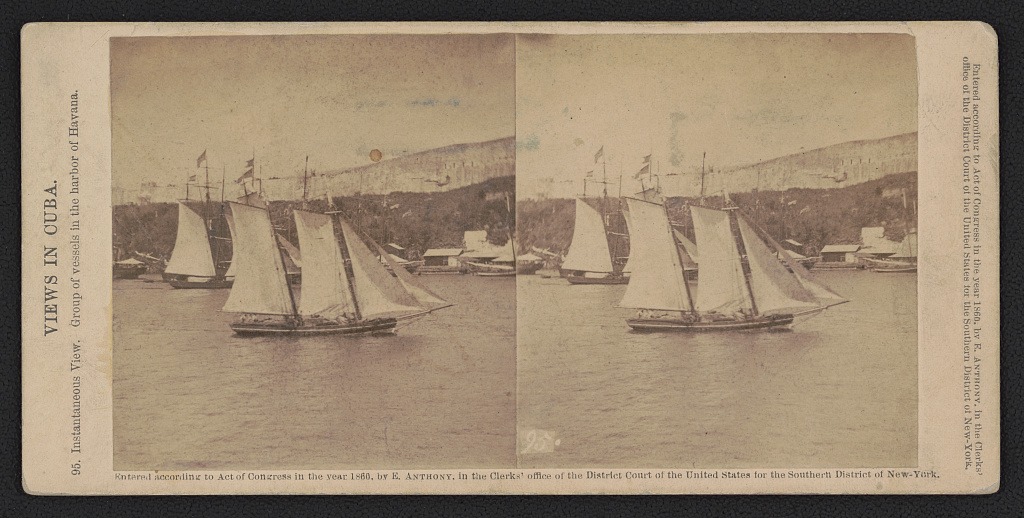
Sailing vessels in Havana harbour, circa 1860, in a stereograph by George N. Barnard. This archival harbour view provides geographical and period context; the vessels’ cargoes are not identified. Image source. George N. Barnard (1819–1902), photographer, as catalogued by the Library of Congress / Library of Congress. Public domain.
Tobacco offers an unusual map of the Caribbean. Follow it through the historical record and the familiar boundaries between islands begin to give way to another geography: farming districts, shipping ports, exile communities and markets across the Atlantic.
Cuba occupies an important place on that map, but a history organised entirely around Havana misses much of the story. The Dominican countryside, Jamaican export agriculture and the Cuban communities of Florida reveal different ways in which the crop connected people. Some connections followed official trade routes. Others developed against the wishes of colonial authorities or through the disruption of war.
The result was never a single, uninterrupted Caribbean industry. It was a changing set of relationships, with unequal rewards and very different experiences of work.
Before the export economy
Tobacco’s commercial history begins with a fundamental distinction: Europeans encountered a plant already known and used by Indigenous peoples in the Americas. They did not introduce tobacco to the Caribbean. The National Park Service’s historical account describes European encounters with tobacco in the islands at the end of the fifteenth century, followed by its circulation in Europe. National Park Service
The expansion of that trade changed the scale and purpose of production. The Smithsonian’s account places Spanish merchants in the sixteenth-century transatlantic trade, followed by English participation in the seventeenth century. It also identifies the people behind the commerce: merchants, sailors, indentured workers and enslaved people who cultivated and processed tobacco. Smithsonian National Museum of American History
These commercial connections included coercion: the enslaved people in this Atlantic economy were compelled to labour. That context matters, although it should not be used to suggest that every Caribbean tobacco district had the same labour system.
A crop beyond colonial control
In the Cibao, in what is now the Dominican Republic, tobacco supported a rural economy that did not fit neatly into Spain’s preferred system of colonial administration.
Historian Michiel Baud describes smallholders whose production and commerce repeatedly escaped official control. Tobacco entered unauthorised trading networks as European demand increased. Over the longer term, colonial control remained incomplete.
Baud’s study also shows why it is misleading to treat all Caribbean export agriculture as interchangeable. Family labour and smallholdings were central to the Cibao tobacco economy. Farmers were connected to distant markets without simply reproducing the organisation of a large plantation. Michiel Baud, A Colonial Counter Economy: Tobacco Production on Española, 1500–1870, pp. 27–49
Trade could therefore challenge an empire’s authority while creating dependencies of its own. Access to buyers offered opportunities, but it also meant that decisions made far from a farm could matter to the people working it.
Jamaica and the movement of people
Cuban refugees arriving during the nineteenth-century wars for independence linked Jamaica to this wider history of displacement and trade.
Historian Howard Johnson’s study of migration between 1868 and 1898 identifies the development of tobacco into a viable Jamaican export staple as a long-term economic consequence. Johnson also describes a welcome influenced by the racial preferences of Jamaican elites. His findings connect refugee migration with economic change while showing that reception was shaped by unequal social relationships. They concern an export industry, not the first arrival of the plant. Howard Johnson, Cuban Immigrants in Jamaica, 1868–1898
Across the Straits of Florida
The connections extended beyond the islands themselves. During the later nineteenth century, cigar companies moved from Cuba to Florida, in part to avoid tariffs and trade restrictions. Workers followed, helping establish Cuban communities in Key West and Tampa. The Library of Congress describes continuing movement between Cuba and these centres as employment allowed. Library of Congress, Crossing the Straits
The resulting communities make Florida part of this regional history. Following the movement of workers alongside that of goods gives a fuller account of how the industry crossed borders.
The geography changes again
The Dominican Republic’s later development cannot be understood only as an extension of Cuba. Its tobacco history was already centuries old when new movements of capital and people altered the industry after the Cuban Revolution of 1959.
Historian Jean Stubbs examines how Cuban emigrant tobacco families and US commercial interests helped reshape Dominican production. Her research connects that shift to the search for alternatives to Cuban leaf as trade restrictions changed access to the US market. Jean Stubbs, Reinventing Mecca: Tobacco in the Dominican Republic, 1763–2007
Read alongside the earlier histories, this is a reminder that commercial centres are made through politics, labour and investment. They are not permanent features of a map.
These histories show different relationships between agriculture, commerce and migration. Cibao smallholders, Cuban refugees in Jamaica and workers crossing to Florida cannot be folded into one account of progress. Together, they place the people and conditions behind the trade at the centre of the Caribbean story.