
The Edit · Historical and cultural analysis
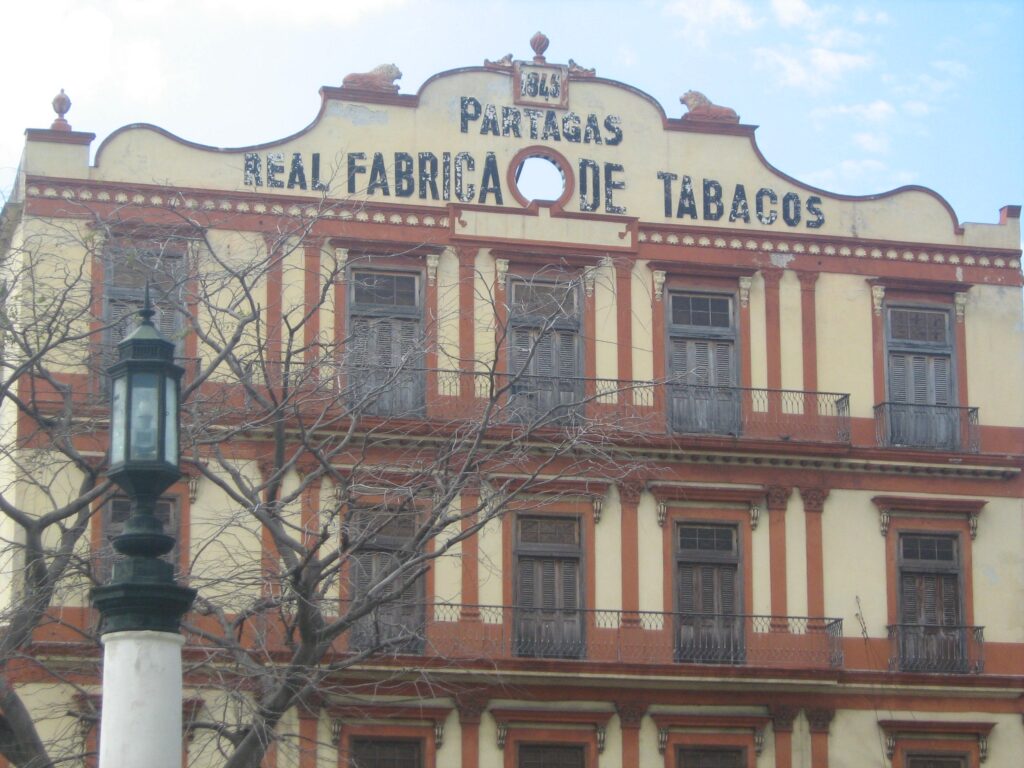
The historic Partagás factory building on Industria Street in Havana. Production later moved to another location. Narezz / Wikimedia Commons, CC BY 3.0. Uncropped; automatically resized for web display.

The history of Cuba’s cigar industry reaches far beyond its celebrated names, connecting Indigenous agriculture, colonial commerce, skilled labour and the cultural life of Havana.
Long before Cohiba, Montecristo or Partagás became internationally recognised names, tobacco was part of the agricultural and cultural life of the Americas.
Indigenous communities cultivated and used tobacco centuries before European colonisation. Its subsequent movement across the Atlantic transformed an established American crop into an international commodity, eventually connecting Caribbean agriculture with European commerce and manufacturing.
Cuba became closely associated with that trade, developing a cigar industry whose reputation would endure through political upheaval, changing ownership and the emergence of competing production centres elsewhere in the Caribbean and Central America.
The familiar names tell only part of that history. The fields, factories and people behind them tell another.
Tobacco, Colonialism and the Making of an Industry
European demand for tobacco developed within the colonial Atlantic economy, where agricultural production was shaped by unequal access to land, coercive labour systems and commercial networks connecting the Americas, Europe and Africa.
Enslaved Africans were part of the wider plantation economy that sustained Atlantic commodity production. The development of Cuba’s tobacco sector also involved farmers, merchants, agricultural labourers and skilled manufacturing workers operating under changing systems of landholding and employment.
That history complicates the romantic image of a traditional industry preserved unchanged across generations.
The knowledge associated with tobacco cultivation and cigar manufacturing developed through human labour, commercial exchange and adaptation. The industry’s international reputation emerged from those processes rather than from a single founder, factory or celebrated brand.
By the nineteenth century, Havana had become an important centre of cigar manufacturing, with factories serving both domestic and export markets.
Those factories would develop their own commercial identities and distinctive cultural traditions.
Three Names, Three Periods of Cuban History
Partagás, Montecristo and Cohiba illustrate how cigar brands became connected to different periods of Cuba’s development.
Partagás and Nineteenth-Century Havana
Partagás traces its establishment to 1845 and the enterprise associated with Jaime Partagás.
Its history became closely linked with Havana’s industrial landscape, particularly the historic factory on Industria Street. That building later ceased operating as the brand’s production site, with manufacturing relocated during the twenty-first century.
The name remains an important part of Havana’s cigar-manufacturing history, but the factory itself should be understood as a historical landmark rather than assumed to represent the brand’s present production location.
Partagás is also associated in cigar-industry accounts with the development of the factory lector tradition, in which literature and news were read aloud to workers.
The broader practice dates to nineteenth-century Cuban factory culture and became an enduring feature of the industry’s social history.
Montecristo and the Factory Reading Tradition
Montecristo was established in 1935, nearly a century after Partagás.
Its name refers to Alexandre Dumas’s The Count of Monte Cristo, a novel associated with the reading traditions of Cuban cigar factories.
That connection illustrates how literature entered the working environment of industrial Havana.
The lector was more than a source of entertainment. Readings introduced workers to novels, newspapers and public affairs, connecting factory life with wider intellectual and political conversations.
Montecristo inherited that cultural association. It did not originate the reading tradition itself.
Cohiba and Revolutionary Cuba
Cohiba belongs to a different historical moment.
Habanos dates Cohiba’s creation to 1966 and describes an early role in official gifts to Cuban and foreign public figures. That is the company’s retrospective account, rather than a contemporary production record.
Historian Jean Stubbs gives different dates in her 2000 article on the Cuban cigar sector in the 1990s, “Turning Over a New Leaf? The Havana Cigar Revisited”. On page 240, in a short passage that cites no source for these dates, she places first manufacture in 1968 and describes El Laguito as having begun as a school for women cigar rollers in 1961, when prestigious export rolling was dominated by men. Her account adds the history of training and work to the history of the name.
Participant testimony adds another perspective. In James Suckling’s Autumn 1995 interview, Eduardo Rivera Irizarri recalled directing El Laguito from its beginning in 1963 until 1970. His account places the first use of the Cohiba name in 1966, after earlier gifts of unbranded cigars.
That recollection supports separating earlier cigars from brand naming, but does not resolve Stubbs’s 1968 date. Nor should the school and factory beginnings be silently made into one event. Habanos’s 2022 account also describes cigars being made at El Laguito before 1966. Together, these retrospective sources leave the exact early institutional chronology unsettled.
For the later commercial phase, Habanos gives 1982 for presentation in international markets; Stubbs places commercialisation in the early 1980s. This broad sequence distinguishes an early state-associated role from wider distribution without turning the unresolved early dates into a definitive chronology.
Unlike the nineteenth-century enterprises that preceded it, Cohiba’s origins are closely connected to the institutions and international relationships of the Cuban revolutionary state.
Together, these three names provide a condensed history of changing Cuban commercial identity, from nineteenth-century industrial Havana to twentieth-century political transformation.
The Workers Behind the Reputation
The history of Cuban cigars is also a history of specialised labour.
Agricultural workers cultivate and prepare tobacco. Factory employees perform distinct manufacturing tasks, while torcedores, the skilled workers associated with hand-rolling, represent one of the industry’s most recognisable craft traditions.
Their work depends on training, experience and the transmission of knowledge within an established manufacturing culture.
The prominence of the finished product can obscure that human history.
Factories were workplaces, but they were also sites of social organisation, discussion and cultural exchange. The lector tradition is one example of how industrial labour and intellectual life intersected.
Understanding the industry requires attention to the people who produced its goods, not simply the commercial identities attached to them.
A Cuban History That Extends Beyond Cuba
Cuba’s influence on cigar manufacturing did not remain confined to the island.
Migration, investment and political change helped carry expertise and commercial relationships into other countries, particularly during the twentieth century.
The Dominican Republic, Honduras and Nicaragua developed important cigar-manufacturing industries with their own histories and production traditions.
These developments form part of a larger Caribbean and Central American story about the movement of people, agricultural knowledge, capital and manufacturing expertise.
Cuba remains central to that history, but it is not its only subject.
For a Caribbean publication, this broader perspective is essential. The region’s tobacco heritage belongs within the history of agriculture, migration, industrial development and international trade.
Looking Beyond the Label
Historic packaging, factory photographs, trade records and surviving buildings offer valuable evidence of how the Cuban cigar industry represented itself.
They also reveal the difference between commercial mythology and historical documentation.
A brand may draw on literature, political identity or a celebrated founder. Those associations can be culturally significant without telling the complete story of the people and institutions involved.
The enduring interest of Cuban cigar history lies in that complexity.
Its legacy is visible in the names that survived, but also in the agricultural communities, factory workers, migration patterns and commercial relationships that made those names possible.
The history is larger than the label.
Sources and further reading
National Park Service — early history · Smithsonian — Atlantic trade and labour · Partagás official history · Montecristo official history · Cohiba official history · Araceli Tinajero, El Lector · Jean Stubbs — Dominican tobacco history